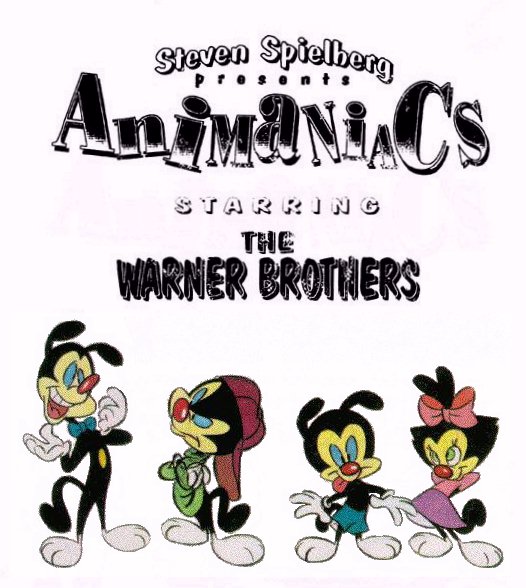
Standing below an early concept logo, from left to right:
The Warner Brothers -- Yakky, Smakky & Wakky -- and their sister.
Standing below an early concept logo, from left to right:
The Warner Brothers -- Yakky, Smakky & Wakky -- and their
sister.
Although Steven Spielberg Presents Animaniacs made its television debut
on September 13, 1993, it obviously had been in production for a while before
that. Even before the production began, though, there was the thought process:
What characters will be in the show? What will they be like? What will they be
called? Some ideas were abandoned before production, while others evolved from
their initial concepts into what we all saw on the screen.
Take the Warners themselves for instance. If you think that prototype form seen
above is strange, imagine them all as ducks! Yes, the initial concept was for the
stars of Animaniacs to be ducks.
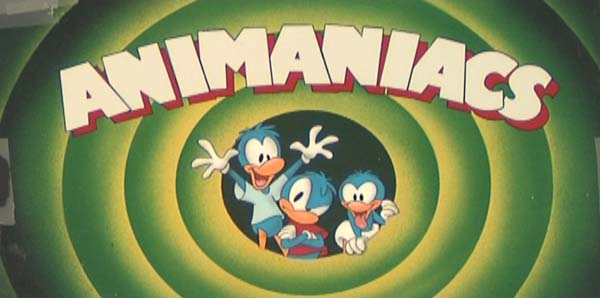
At this time, Disney had Darkwing Duck and Ducktales, and of course
Warner Bros. had a popular character in Plucky Duck from Tiny Toon Adventures.
This led Tom Ruegger and Steven Spielberg into thinking, "Ducks have been done to death," as
Ruegger was quoted in a 1993 Animation Magazine, and has said in other conversations.
The reason for the ducks was given by Tom in a 2010 post on the ToonZone Warner Bros. Club forum:
The three ducks in "the rings" were based on characters from an animated cartoon I made in my film school days: "The Premiere of Platypus Duck." Spent two years animating, painting and shooting this 11-minute "epic," then used this film as the showpiece in my job-interview with Bill Hanna at Hanna-Barbera. (I got the job -- as an assistant animator. I was very happy.)
This particular drawing of "the three ducks in the green rings" was done by Ken Boyer and/or Alfred Gimeno and has the influence of both. Over the course of a week or two, Ken, Alfred, Lynn Naylor, a few other artists and I were involved in turning these ducks into "the generic 30's-style cartoon characters" (the Warner brothers and their sister Dot) that we've come to know. Once we had a handle on their origin story, the designs came together fairly quickly.
The transformation into the nondescript animated ink blot characters began with
simply putting a big red nose on the bill of the duck prototype. As for who
these brothers would be, I recall that Ruegger once said that he looked
out one day and saw the WB water tower in Burbank off in the distance, and had
an epiphany: Call them Warner Brothers, and have them live inside that tower!
For character traits, Ruegger looked no further than his own three sons -- Nate,
Luke and Cody. They were the basis of Yakky, Smakky and Wakky. Obviously, Yakky
was a chatty one. Smakky, as the name and image above suggests, was an ill-tempered
character. Ruegger said during Animania IV that Luke had been going through a phase
at the time where he was slapping people. Wakky was to be the odd one, full of
energy and able to pull anything out of his sack.
So who's this little girl character with the three boys? I've never heard a name
for this character (fans have dubbed her "Proto-Dot"). My supposition,
based on the model sheet above and just her apparent age, was that she was an
unrelated character who was smitten with Wakky, though I would doubt that Wakky
would want anything to do with girls. Some comic potential there, perhaps.
However, Tom Ruegger has since posted: "In any and all different configurations
and incarnations and drawings of the characters, from their inception, they were
always siblings. Whether the lineup of Warners was three boys, three boys and a
girl, two boys and two girls, or two boys and one girl, in every case, they were
siblings. As a concept and by definition, the Warners are and were siblings."
Of course, things changed! It's pretty straightforward that Yakky became Yakko
(and they gave the kid some clothes, for heaven's sake).
For the creation of Wakko, it's obvious that elements of both Smakky and Wakky
were merged. He still has the ill-tempered streak, though certainly smacking wouldn't
be tolerated by the network censors, so the large wooden mallet would have to
suffice. He also, however, has the wackiness. Physically, he took the dangling
tongue of Wakky as well. Perhaps this is why Wakko was so popular; he simply
had more traits, being a convergence of two characters.
Without really knowing what traits Proto-Dot was meant to have, it's difficult
to say if any of Cody Ruegger's traits were left for her to have, or if they
all went to Wakko. In 1995, Tom Ruegger said, "Initially, Cody was upset that
he got turned into a girl, but now he loves Dot." Whether that's a reference
to character traits or simply the switch to making Dot one of the siblings, I don't
know.
Many of the Warners' routines came straight from the Ruegger household, e.g.,
"I don't want to hear another peep out of you!" / "Peep! Peep!
Peep!" Certainly, living with three children the approximate ages of the
characters in the show provided a wealth of material for Ruegger to use.
Even after Yakko, Wakko and Dot were finalized as characters, there still were
traits left to figure out, and ideas that wouldn't make it. Larissa Norman and
Emily Shoop bought a copy of a December 1991 revision of the Animaniacs writers'
bible. Their scanned images are no longer online. However, back in 1999, in the
interests of readability and download speed, I had typed out the entire text:
Animaniacs
Bible.
In it, you'll see some sample dialogue for the characters which never was used.
I'm sure that the idea of Dot accusing people of "sexual harrassment"
didn't go over well with the censors for Fox Kids.
There's a note also about hoping for Steven Spielberg's influence to bring in
celebrity guest stars to voice their own caricatures. This didn't happen probably
because Spielberg was in Europe filming Schindler's List.
On the final page, there's a list of the "franchises" -- some you'll
recognize, but many you won't! Even at this later stage, there were some character
ideas kicking around. Let's go over them, and, after that, mention some franchise
ideas which already were abandoned before this version of the bible was written.
Note the presence of Mindy & Buttons. The story goes that Steven Spielberg had
model sheets of potential franchises scattered about at home as he was deciding
what to approve and what to disapprove, when his young son pointed at Mindy and
said, "She's cool." Just like that, Mindy & Buttons were in.
Obviously, the names of the Goodfeathers hadn't yet been finalized, as they were
at this stage called Frankie, Joey Z and Gary (Bobby, Pesto and Squit?).
The Hip Hippos are fairly high on the list here, though they are named
John and Martha. Apparently the idea to have them as rich foreigners
hadn't come to mind yet, which would give rise to their new names,
Flavio and Marita.
A note of "(HOLD)" is listed here for Bossy Beaver & Doyle.
This franchise never made it, as they were deemed too similar to Pinky & The Brain.
Bossy Beaver, according to Tom Ruegger, was obsessed with building "the
best damn dam ever" but his plans would be foiled by his dopey sidekick, Doyle.
Minerva Mink apparently first was called Marilyn Mink -- perhaps the intent
was to make her more like Marilyn Monroe. Newt was planned as a regular foil
for her (or would that be the other way round?), so it was no fluke that he
reappeared in later episodes.
I have heard nothing of The Fleas other than those two words written in the
character list. The supposition comes to mind that it would be a continuation
for the flea characters introduced in a Tiny Toon Adventures episode.
Clyde & Egghead Jr. -- the same Egghead Jr. seen in the Foghorn Leghorn
cartoons and again in Tiny Toons? Most likely. I'm not sure who Clyde would
have been, though.
Mr. Skullhead was meant to be a regular franchise!
Not only do I not know what La Tidga was supposed to be; I also don't
even know what it means! As far as I can tell, it's not Spanish or
Italian ...
That's the end of the character list from that December 1991 revision
of the writers' bible, but there were other ideas which had been abandoned
before that.
As The Petri Dish Turns was conceived as a soap-opera parody, following the
lives of microscopic organisms, and the complications that cell division
might have on a relationship. There may have been some amusing things to
do with that, but perhaps it would have required too much exposition, or
wouldn't have been fast-paced enough. Whatever the reason, this concept
didn't go far.
Nipsy & Russell were to be two raccoons. Whether the idea was to have
the comedian Nipsy Russell do their voices, or for their voices to be based
on him, or their routines to be based on him, I don't know. Perhaps it was
doomed over the fear of backlash for naming a pair of raccoons after a black
comedian ("coon" used to be word for a stereotypical black
character, sort of the black equivalent of "redneck"). Certainly,
having any black character or "black-sounding" character in a
cartoon is tricky, because if the character is ever shown to be incompetent,
stupid or villainous, the backlash would be severe. Unfortunately, there has
to be a double standard in broadcasting (kids' programming especially),
because the issue of race is still very sensitive. (For example, if you
have seen the American version of Whose Line is it Anyway? you
will have seen Wayne Brady, a black performer, imitate many white actors
and singers. On the other hand, the white performers never imitate any
black actors or singers, because it would be construed as racist.)
As for the Warners, even after production had began, their design changed, forcing animators to re-do or re-touch some of their finished work. The change was the addition of the tufts/whiskers on the boys' heads, and changing Dot's ear bow to a flower. Ruegger explains:
Warner Bros. CEO Bob Daly personally drew in some of the side whiskers on Yakko and Wakko after he thought he saw "a giant Mickey Mouse balloon climbing on the Warner Bros. water tower." In fact, it was a Yakko balloon that we had arranged to place on the tower, but since Bob could not tell the difference between the two characters at that time, he insisted that whiskers be added to the Warner brothers.
Well, this is all I can think about, off the top of my head, for the moment!
Let me know if there is anything I "forgot"...
8 September 2003
22 January 2010